
The best accounting software for your business depends on your size, budget, and what you actually need it to do. Three names dominate the accounting software conversation: Xero vs MYOB vs QuickBooks. Each platform is built differently, priced differently, and suited to different business needs.
Cloud accounting has changed how businesses manage invoices, payroll, and cash flow. The right online accounting software gives you a real-time view of your finances from anywhere, no more desktop headaches or end-of-year scrambles.
The right choice depends on your business needs.
- Xero – The most popular cloud-based option for small business, praised for its user-friendly interface and wide integration library
- MYOB – A long-standing favourite in the Australian accounting market, known for robust local compliance and payroll features
- QuickBooks – A globally recognised platform that offers strong features at a competitive price point
Quick verdict: who should choose what?
Not every business has the same needs.
Choose Xero if you’re a small business or startup that wants a user-friendly, cloud-based platform with a wide range of integrations and a clean, modern interface.
Choose MYOB if you’re an established Australian business that needs robust payroll, inventory management, and strong local compliance support.
Choose QuickBooks if you’re a small to medium business looking for a feature-rich, cost-effective solution with flexible plans that scale as you grow.
Still not sure? The sections below break it all down, so you can find the right accounting software for your business with confidence.
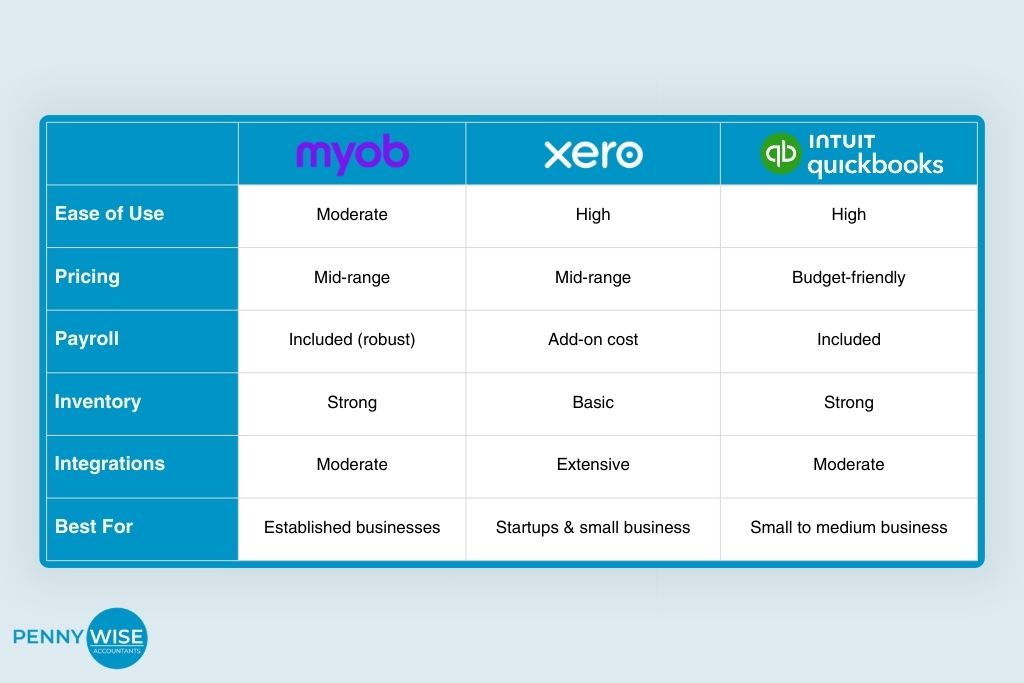
Comparison at a glance
Here’s how the three platforms stack up across the features that matter most. The right choice comes down to more than a quick comparison, let’s dig deeper into what each platform actually offers.
Xero: features, pros, and cons
Xero is the most popular cloud accounting software in the local market, and it’s easy to see why so many small business owners make the switch.
Launched in New Zealand and now dominant across the Pacific region, Xero has built its reputation on ease of use, a clean interface, and an extensive integration library. It connects with over 1,000 third-party apps, making it one of the most flexible online accounting software options available today.
Key features
- Cloud-based access from any device
- Invoicing, bank reconciliation, and cash flow tracking
- Xero payroll (available as an add-on)
- Inventory management at a basic level
- Over 1,000 integrations including Stripe, Shopify, and HubSpot
- Real-time financial reporting and dashboards
- Multi-currency support on higher-tier plans
Pros vs cons
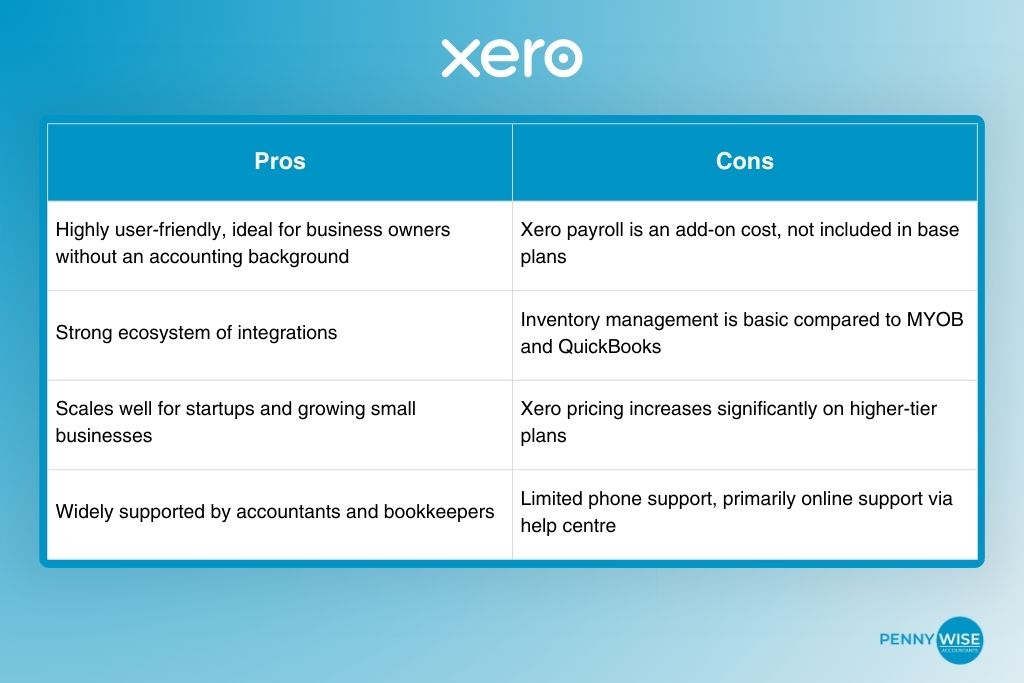
Xero sits comfortably as a strong all-rounder, but it’s not the only capable option in the market. Next, let’s look at what MYOB brings to the table.
MYOB: features, pros, and cons
MYOB has been around longer than most of its competitors, and for good reason. It remains one of the most trusted names in business accounting, particularly for businesses that need strong local compliance and payroll support.
MYOB offers both cloud-based and desktop accounting options, giving businesses flexibility in how they manage their finances. MYOB AccountRight is its flagship product, designed for businesses that need more advanced features like detailed inventory management, job tracking, and multi-currency support. For simpler needs, MYOB Business Pro provides a streamlined online accounting software experience.
Key features
- Cloud-based and desktop version available
- Robust payroll and Single Touch Payroll (STP) compliance
- Inventory management and job tracking
- Invoicing, bank feeds, and cash flow reporting
- MYOB AccountRight for advanced business accounting needs
- BAS and GST reporting built in
- Unlimited users on certain plans
Pros vs cons
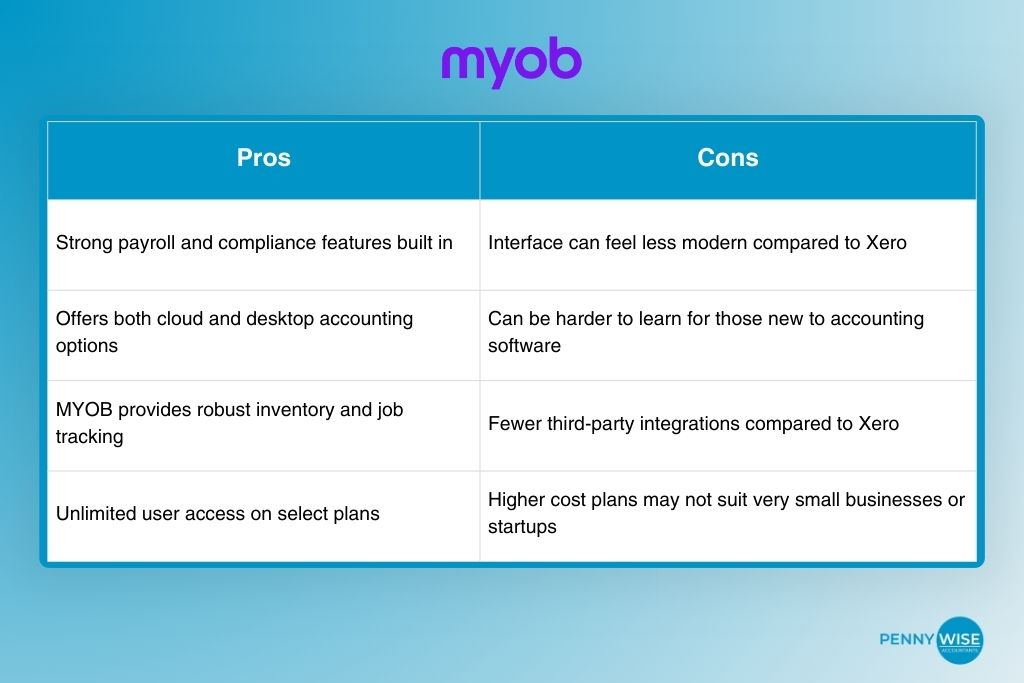
MYOB remains a dependable choice for businesses with more complex needs, but it’s worth seeing how QuickBooks compares before making your final call.
QuickBooks: features, pros, and cons
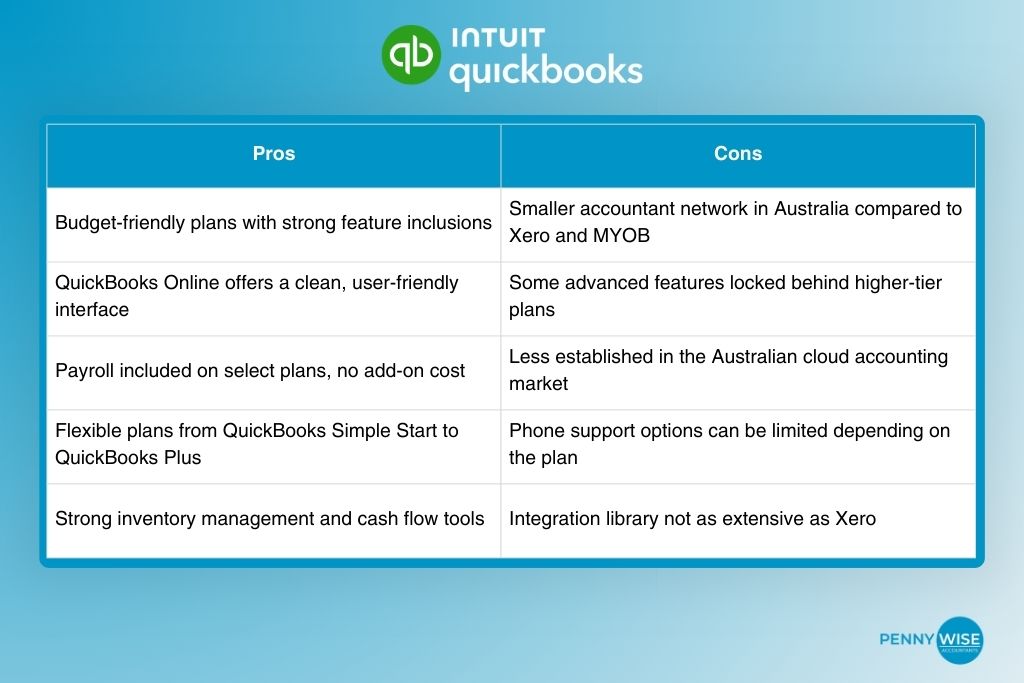
QuickBooks is one of the most recognised accounting software platforms in the world, and it’s building a stronger presence in the Australian market. Developed by Intuit, QuickBooks Online offers a feature-rich experience at a price point that suits small to medium businesses watching their bottom line.
QuickBooks is known for its intuitive interface and flexible plan structure. From QuickBooks Simple Start through to QuickBooks Plus, businesses can choose a plan that fits their current needs and scale up as they grow. It’s a particularly strong option for business owners who want capable accounting and bookkeeping tools without the complexity.
Key features
- Cloud-based access via QuickBooks Online and mobile app
- Invoicing, expense tracking, and bank reconciliation
- Payroll included on select plans
- Inventory management on higher-tier plans
- Cash flow monitoring and financial reporting
- Integration with popular third-party apps
- QuickBooks Simple Start for sole traders and micro businesses
Pros vs cons
Xero vs MYOB vs QuickBooks: pricing comparison
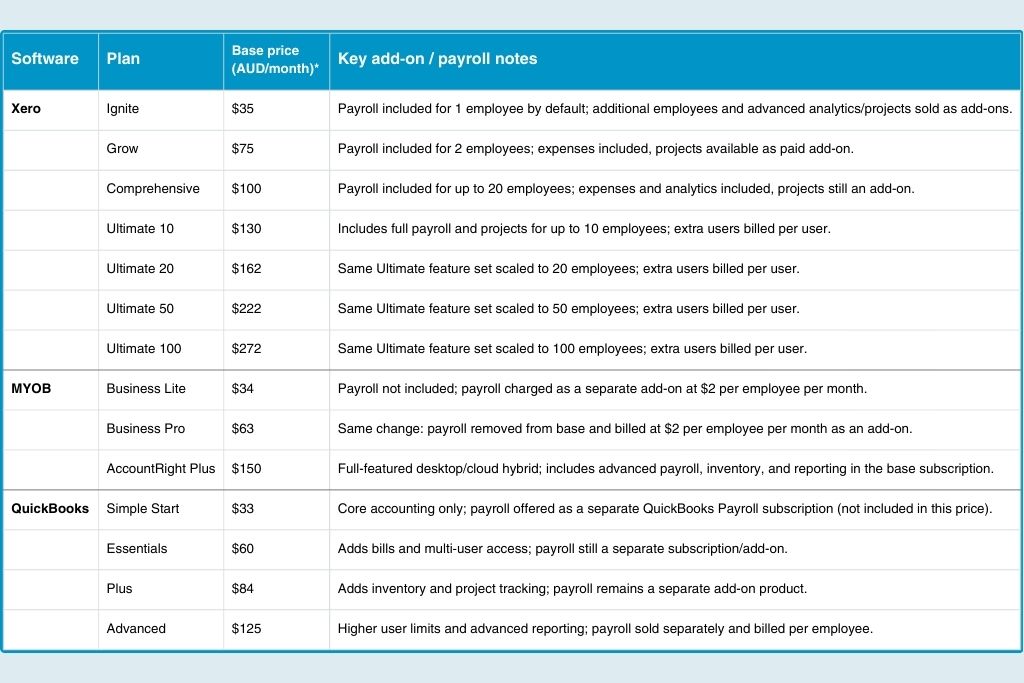
Pricing can make or break your software decision, especially for small business owners managing tight budgets. Here’s a clear breakdown of what each platform costs.
Which accounting software do Australian accountants prefer?
At Pennywise Accountants, we work with MYOB, Xero, and QuickBooks, because the right platform depends on the business, not the software.
Every client we work with has different needs, different team sizes, and different ways of managing their finances. That’s why we don’t lock ourselves into one platform. We recommend what fits, then support you in using it properly.
Across the broader accounting industry, Xero is the most widely adopted platform. Its cloud-first design and strong integration ecosystem have made it the go-to choice for modern accounting practices. MYOB remains a close second, particularly for established businesses with more complex payroll and compliance needs. QuickBooks has a smaller local accountant network but is growing steadily.
The right accounting software depends on what works for both you and the people managing your books. If you’re unsure where to start, our team in Sunbury is ready to help you work it out.
Frequently asked questions
How do I switch from MYOB to Xero in Australia?
Switching from MYOB to Xero involves exporting your chart of accounts, contacts, invoices, bills, and bank balances from MYOB then importing them into Xero. Services like MMC Convert or Switch My Books handle migrations securely for free on current and prior year data in about 10 business days. Ensure your MYOB file is up to date first, and manual entry covers post-migration transactions.
Do Xero, MYOB, and QuickBooks offer free trials?
Yes, all three offer free trials: Xero provides 30 days with full access to test features. MYOB and QuickBooks typically give 30 days too, letting you explore plans without commitment before monthly billing.
What’s the best for retail businesses?
MYOB or QuickBooks suit retail best due to strong inventory tracking with multi-location support and stock alerts. MYOB excels for complex needs like manufacturing retail, while QuickBooks offers affordable e-commerce integrations. Xero works for simple online retail but has basic inventory compared to the others.
Which has the most integrations in Australia?
Xero leads with over 1,000 integrations including Shopify, Stripe, and HubSpot for seamless Australian workflows. QuickBooks and MYOB offer moderate options around 650 and fewer, focusing on ATO and payroll apps. This makes Xero ideal for businesses using multiple tools like e-commerce or CRM.


Get a personal consultation.
Call us today at 0405 667 350
Fast responses, clear advice, and tailored solutions for Sunbury individuals and small businesses.