
This guide explains what these services cover, how statutory reporting obligations differ from management reporting and outsourced preparation work, and how to choose a provider that suits your business. It’s written for owners and directors who want to know what’s actually required for their entity, as distinct from what’s simply good practice.
What are financial reporting services?
Financial reporting services cover the preparation, review, and delivery of the financial statements, notes, and disclosures a business uses to track performance, meet compliance obligations, and support decision-making. Depending on the provider, this can also include consolidation support for group structures and broader reporting advisory. Most financial reporting firms prepare profit and loss statements, balance sheets, and cash flow statements as a core service, though not every provider covers all of these; some focus specifically on compilation, advisory, or compliance support.
Unlike day-to-day bookkeeping, financial reporting services focus on the finished product: accurate, standards-compliant statements that a bank, investor, or regulator can rely on.
Statutory reports vs Management accounts
Statutory reports are prepared for legal and compliance purposes. Reports required under the Corporations Act 2001 follow prescribed accounting standards, and the lodgement timeframe set by ASIC depends on the entity’s type and circumstances rather than being the same for every business. Management accounts, by contrast, are internal reporting packs: prepared voluntarily and shaped around however the business wants to track its own performance.
Special purpose vs General purpose reports
Reporting can be prepared as a special purpose or a general purpose financial report. Which one applies depends on whether the entity is considered a reporting entity, its reporting obligations, and who relies on the statements, rather than simply the size of the business, so it’s worth getting this right at the outset.
For example, a small proprietary company reporting only to its own directors, who can request whatever information they need directly, may prepare a special purpose report, while a large proprietary company with external shareholders who rely on the published statements is more likely to need a general purpose report prepared under full AASB recognition and measurement requirements. This is illustrative only: the correct classification turns on the specific facts, so it’s worth confirming an entity’s reporting status with your adviser rather than relying on the general pattern above.
Why businesses outsource this work
For small and mid-sized businesses, outsourcing financial reporting is often more cost-effective than maintaining an in-house finance team once statutory reporting, BAS lodgements, and audit preparation are all factored in, though cost isn’t the only driver. Many businesses outsource for access to technical expertise, scalability, or better management of compliance risk rather than price alone.
Outsourcing tends to suit businesses that don’t run a full in-house finance function, while larger entities with complex, continuous reporting needs may still be better served keeping this in-house.
What are financial statements for a business?
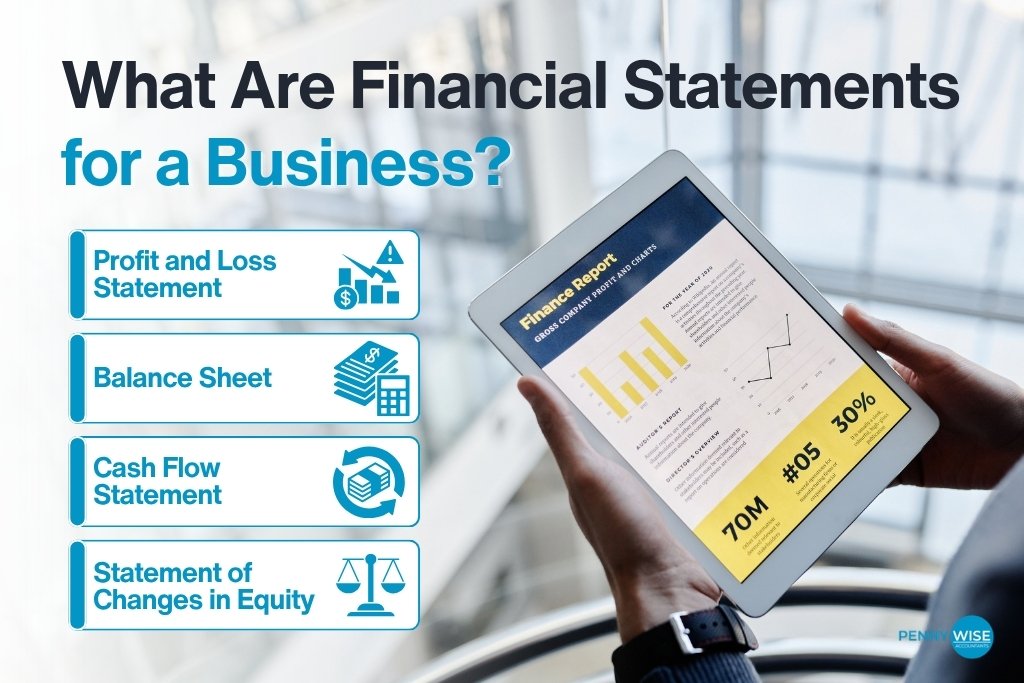
Financial statements are the structured documents that summarise a business’s financial position and performance over a set period. Four statements form the core of most financial reporting engagements. Depending on the entity’s reporting framework and structure, some businesses also need supporting notes and disclosures, or consolidated statements for a group of related entities.
Profit and loss statement
The profit and loss statement (also called an income statement) shows revenue, expenses, and net profit over a defined period, usually a month, quarter, or financial year. It’s the statement most owners check first because it answers a simple question: did the business make money?
Balance sheet
The balance sheet is a snapshot of what a business owns and owes on a specific date. It lists assets, liabilities, and equity, and it’s the statement lenders scrutinise most closely when assessing whether a business can service debt.
Cash flow statement
The cash flow statement tracks the actual movement of cash in and out of the business, split across operating, investing, and financing activities. A business can be profitable on paper and still run out of cash, which is why this statement matters just as much as the profit and loss report.
Statement of changes in equity
Less commonly discussed but still important, this statement tracks movements in owner’s equity over the reporting period, including retained earnings and any dividends or drawings. It’s particularly relevant once a business has multiple shareholders or is preparing a general purpose report.
Why financial reporting matters for Australian businesses
Financial reporting isn’t just a compliance box to tick. It underpins trust with regulators, lenders, and the people who back your business financially.
Compliance with Australian Accounting Standards
Businesses required to lodge financial reports must prepare them in accordance with Australian Accounting Standards Board (AASB) standards, which align closely with International Financial Reporting Standards (IFRS). Getting this technical detail wrong can mean rejected lodgements, regulatory scrutiny, or the need to restate prior reports.
Staying current on standard updates is part of what a reporting provider offers, since AASB releases change from time to time and apply differently depending on entity type. Sustainability reporting requirements are also an evolving area for some larger and public interest entities, so it’s worth confirming current applicability with your adviser or against current AASB and ASIC guidance rather than assuming a fixed rule.
The exact timeframe and scope depend on the entity’s size and structure, so it’s worth checking ASIC’s current guidance on financial reporting and audit rather than relying on a single date.
Building trust with investors and lenders
Accurate, timely financial statements are the primary evidence a lender, investor, or acquirer uses to assess a business. Reports that are inconsistent, late, or prepared without reference to proper accounting standards tend to trigger deeper due diligence and slower finance approvals.
A track record of clean, well-presented statements is one of the simplest ways to build confidence with anyone assessing your business from the outside.
Do you need to lodge financial reports with ASIC?
Whether your business must lodge financial reports depends on your entity type and size, not your industry. This is one of the most common questions business owners ask before deciding whether to hire a financial reporting provider.
Public companies and large proprietary companies generally must prepare, audit, and lodge annual financial reports with ASIC. A proprietary company is classified as large if it meets at least two of the following: consolidated revenue of $50 million or more, consolidated gross assets of $25 million or more, or 100 or more employees. A company that doesn’t meet at least two of those thresholds is classified as small.
Lodgement deadlines are set out in the Corporations Act: disclosing entities, registered schemes, and registrable superannuation entities generally have three months after the end of their financial year to lodge, while other reporting entities, including large proprietary companies, generally have four months. These are the standard timeframes as at the time of writing, so it’s worth confirming the current deadline for your entity type directly with ASIC before relying on it.
Small proprietary companies are not automatically exempt from lodging financial reports with ASIC, even though most aren’t required to. Reporting can still be required if shareholders request it, if ASIC directs the company to lodge, or if the company is controlled by a foreign entity and specific relief doesn’t apply.
Given how these exceptions interact, it’s worth confirming your obligations against your specific circumstances rather than assuming small proprietary status settles the matter on its own.
In short: some companies must lodge financial reports with ASIC, some only need to prepare them without lodging, and some are exempt unless a specific trigger applies, such as a shareholder request, an ASIC direction, or foreign control without relief.
In-House vs Outsourced financial reporting services
Deciding whether to build an in-house finance function or engage outsourced financial reporting services usually comes down to cost, complexity, and how much control you want over the process day to day.
Neither option is universally better. A business with a large finance team and continuous, complex reporting needs may still get more value from an in-house function. A growing business that wants professional-grade statements without the overhead of a full team is usually better served by an outsourced provider.
What to look for when you hire a financial reporting firm
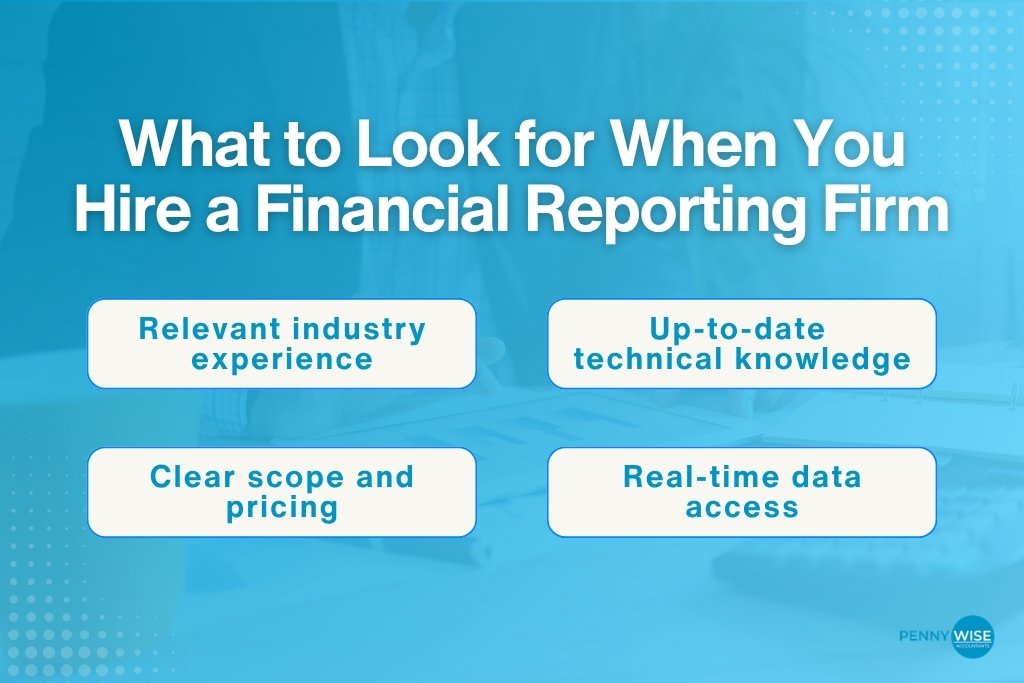
Not all reporting specialists offer the same depth of service, so it pays to check a few things before signing on.
Relevant industry experience. A firm that has worked with businesses in your industry will understand sector-specific reporting quirks, from inventory valuation in retail to revenue recognition in construction.
Up-to-date technical knowledge. Ask how the firm keeps current with AASB and IFRS changes, and whether that knowledge is passed on to clients proactively rather than only when something goes wrong.
Clear scope and pricing. A reliable provider should be upfront about what’s included (statement preparation, BAS lodgements, audit liaison, advisory) and what falls outside the engagement.
Real-time data access. If the firm also provides bookkeeping or cloud accounting support, look for real-time or near-real-time access to your financial data, rather than reports that only arrive weeks after the period closes. This can make it easier to spot issues, such as underpaid Goods and Services Tax (GST) or miscalculated superannuation, before they become a bigger problem, though this is more a bookkeeping/software feature than a core financial reporting service.
Experience with your entity type. A firm that regularly works with your entity type, whether sole trader, trust, or proprietary company, will understand which reporting obligations actually apply to you rather than applying a one-size-fits-all approach.
Director-ready reporting. Look for statements and summaries that are clear enough for directors and other non-accountants to review and sign off on, not just technically compliant documents.
Ability to liaise with auditors. If your business is audited, or might be in future, check whether the firm can work directly with your auditor to keep the process efficient.
How financial reporting services streamline everyday tasks
Financial reporting itself centres on annual and periodic statements, but many providers also offer, or partner on, adjacent accounting and compliance support that helps businesses stay on top of day-to-day obligations. The items below sit alongside core reporting work rather than forming part of it:
- BAS lodgements. Preparing and lodging Business Activity Statements accurately and on time to avoid ATO penalties.
- Profit and loss and balance sheet reviews. Monthly or quarterly reviews that flag issues early, rather than at year-end.
- Forecasting and budgeting support. Turning historical financial data into forward-looking forecasts to support better decision-making.
- Audit preparation. Assembling and reconciling records so an external audit runs efficiently rather than dragging on.
This kind of ongoing support is often what separates a full-service provider from a once-a-year compliance exercise, giving a business a continuous, data-driven view of its financial position rather than a single annual snapshot.
Financial reporting vs Audit vs Assurance services
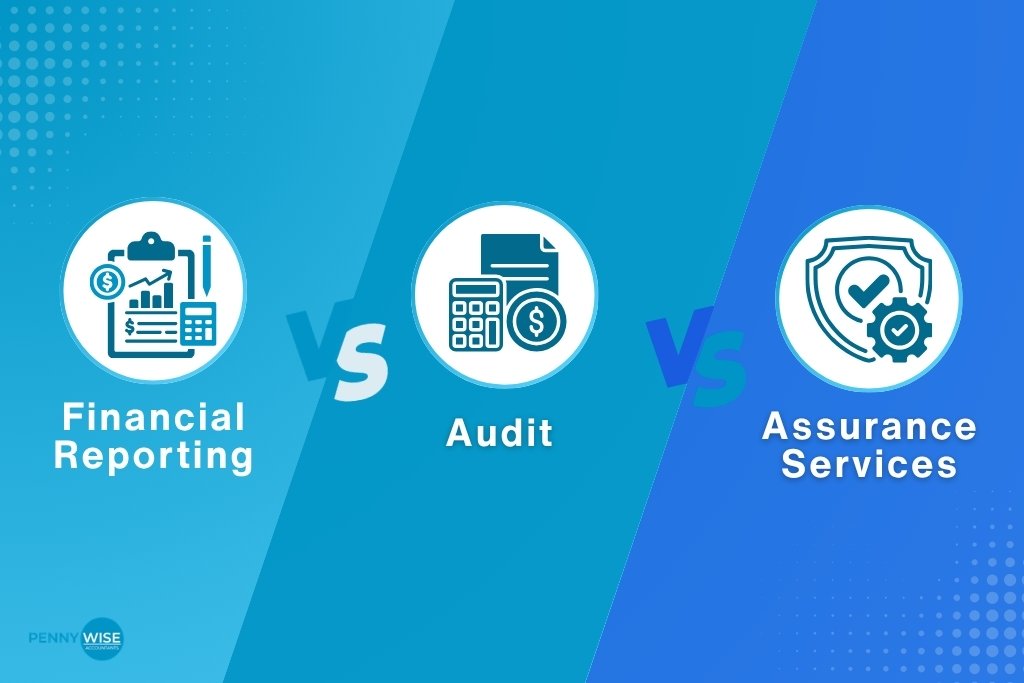
These three terms get used interchangeably, but they describe different things.
Financial reporting is the preparation of the statements themselves, along with any required notes and disclosures.
Audit is an independent examination of those statements by a registered auditor, resulting in an opinion on whether they’re free of material misstatement. Whether an audit is required depends on the company’s type, its reporting status, and whether any ASIC relief applies, so this is worth confirming for your specific entity rather than assuming a blanket rule applies.
Assurance services are broader than audit and don’t always run alongside it. They cover a range of engagements, such as reviews of internal controls or specific transactions, offered at different levels of assurance and for different objectives, not just as an audit add-on.
A financial reporting firm may offer one, two, or all three of these services, so it’s worth clarifying exactly what’s covered before you engage one.
Staying ahead of your reporting
At Pennywise Accountants, the pattern we see most often when preparing financial statements for businesses across Sunbury and Melbourne is owners recognising the value of good reporting only once they’re applying for finance or facing an audit deadline. Setting up your reporting properly from the start, and reviewing it regularly rather than once a year, tends to save far more time and stress than catching problems late.
If it would help to talk through where your business stands, you can book a consultation at a time that suits you — there’s no obligation.
Frequently asked questions
How much do financial reporting services cost in Australia?
Costs vary depending on business size, entity type, reporting framework, and whether audit support is required. Outsourced providers are generally structured around either a fixed monthly retainer or a project fee for annual statements, with BAS lodgements, forecasting, or audit liaison typically priced as an add-on.
Who needs to prepare financial statements in Australia?
Most small proprietary companies aren’t required to prepare financial reports, though there are specific circumstances where this is required, such as a direction from ASIC or a request from shareholders. Public companies and large proprietary companies almost always need to prepare and lodge them.
What’s the difference between outsourced financial reporting and outsourced bookkeeping?
Bookkeeping covers the day-to-day recording of transactions. Financial reporting takes that data and turns it into the formal statements used for compliance, finance applications, and strategic decisions. Many firms offer both, but they’re distinct services with different levels of technical oversight.
Do sole traders need to prepare financial statements?
Sole traders aren’t required to lodge financial statements with ASIC, since that obligation applies to companies, not individuals. Most sole traders report business income and expenses through their individual tax return instead. Many still prepare a profit and loss statement informally to track performance or support a loan application.
What’s the difference between financial statements and a tax return?
A tax return calculates the tax payable to the ATO based on assessable income and deductions for a financial year. Financial statements are broader, showing overall financial position and performance for owners, lenders, and other stakeholders. Tax returns are often prepared using figures drawn directly from the financial statements.
Can I prepare my own financial statements without an accountant?
Small businesses with simple finances can prepare basic statements themselves using accounting software such as Xero or QuickBooks. It becomes riskier once accounting standards, audit requirements, or multiple stakeholders are involved, where errors can affect compliance or finance approvals. Many businesses handle day-to-day figures in-house and outsource formal statement preparation.
What happens if a company lodges its financial report late with ASIC?
Late lodgement triggers an automatic late fee on top of any other lodgement costs, with a higher rate applying the longer the delay. ASIC updates these fee amounts from time to time, so it’s best to check ASIC’s current fee schedule directly rather than rely on a fixed figure. Repeated non-compliance can eventually lead to further ASIC enforcement action.
How long does it take to prepare a set of financial statements?
Turnaround depends heavily on how organised the underlying records are, but a straightforward small business report can often be completed within one to two weeks. Businesses with messy bookkeeping, multiple entities, or audit requirements typically take longer. Real-time accounting data significantly speeds up the process.
Get a personal consultation.
Call us today at 0405 667 350
Fast responses, clear advice, and tailored solutions for Sunbury individuals and small businesses.