
A sole trader and their business are treated as the same taxpayer, so business income is reported through the individual’s personal tax return.
Sole traders pay tax using individual income tax rates rather than a separate business tax rate. For the 2026–27 financial year, Australian resident tax rates start at 0% for taxable income up to $18,200 and increase as taxable income rises.
This guide explains how tax as a sole trader works, including tax rates, deductions, GST, PAYG instalments and tax return requirements.
How does tax as a sole trader work in Australia?
A sole trader business is owned and run by one person. Unlike a company, it is not treated as a separate taxpayer for income tax purposes.
Business income and allowable expenses are reported in the owner’s individual income tax return. The resulting net business income or loss forms part of the individual’s overall tax position.
How is taxable business income calculated?
Sole traders generally pay income tax based on their net business income rather than total sales or turnover.
For a simple example, a business may earn $100,000 and have $20,000 in allowable business expenses. After those expenses, its net business income would be $80,000 before considering other income, deductions or tax adjustments.
The amount shown as profit in bookkeeping software is not always the same as the amount used for tax purposes. Depreciation, private-use adjustments, non-deductible expenses, trading stock, capital gains, tax losses and other tax rules can change the final figure reported in the tax return.
What happens if a sole trader has other income?
Other taxable income can increase the amount of tax a sole trader pays.
For example, a sole trader may also receive wages, interest, rental income or investment income. These amounts are generally considered together when working out total taxable income.
Australia has a progressive tax system, so different portions of taxable income can fall into different tax brackets.
What is the sole trader tax rate for 2026–27?
There is no separate sole trader tax rate in Australia. Australian resident sole traders generally pay tax at individual income tax rates.
For the 2026–27 financial year, the resident individual rates are:
These are Australian resident individual income tax rates and do not include the Medicare levy. Different rules and tax rates apply to foreign residents and working holiday makers.
Does a sole trader pay tax on the first $18,200?
An Australian resident who is entitled to the full tax-free threshold generally pays no income tax on the first $18,200 of taxable income.
The threshold applies to the individual’s total taxable income. It is not a separate $18,200 threshold for business income, wages or each individual source of income.
A person carrying on a business as a sole trader may still need to lodge an income tax return even when income is below the tax-free threshold.
Does the Medicare levy apply?
The Medicare levy is separate from the income tax rates shown above.
For most Australian residents, the Medicare levy is generally 2% of taxable income. Reductions and exemptions may apply depending on income and individual circumstances.
This means the final tax bill may be different from a simple calculation using the tax brackets. Tax offsets, HELP or other study-loan repayments and other adjustments can also affect the amount payable.
How does a sole trader tax calculator work?
A sole trader tax calculator Australia tool can help estimate how much income tax may be payable based on expected taxable income.
The result should only be treated as an estimate. Other income, deductions, tax offsets, Medicare levy amounts and individual circumstances can all change the final result.
Example of sole trader income tax
Consider a simplified example where a sole trader has:
- $100,000 in GST-exclusive business income
- $20,000 in GST-exclusive allowable business expenses
- $80,000 in net business income after relevant tax adjustments
- no other taxable income or deductions
For this example, the $80,000 is assumed to be the individual’s entire taxable income for the year.
Using the 2026–27 individual tax rates, estimated income tax would be:
- Tax from $18,201 to $45,000: $4,020
- Tax from $45,001 to $80,000: $10,500
- Estimated income tax: $14,520
This example excludes the Medicare levy, tax offsets, HELP or other study-loan repayments and any other adjustments that could affect the final tax bill.
GST is also treated separately. For a GST-registered business, GST collected on taxable sales and GST credits on eligible purchases are generally not simply treated as ordinary business income and expenses when calculating income tax.
What are the main sole trader tax obligations?
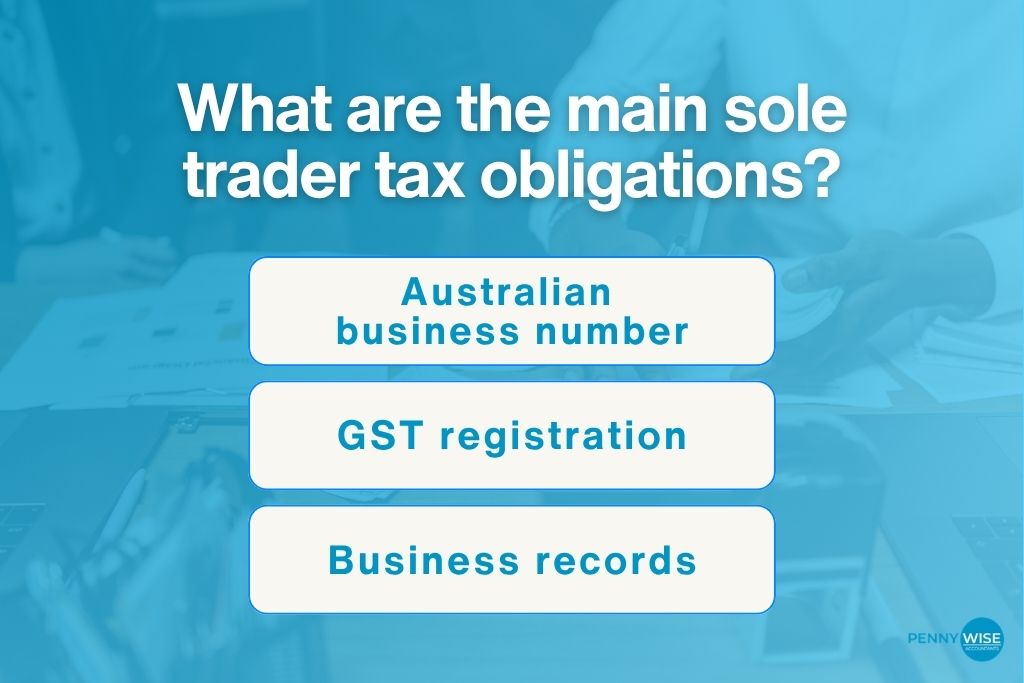
Sole trader tax obligations can involve more than lodging an income tax return once a year.
Depending on the business and its activities, a sole trader may need to consider an Australian business number, GST registration, PAYG instalments, record keeping and other business registrations.
Australian business number
An Australian business number (ABN) is an 11-digit number used to identify a business when dealing with other businesses and government agencies.
An ABN is not automatically required simply because a person earns money from an activity. Entitlement generally depends on whether the person is carrying on an enterprise and meets the relevant requirements.
ABN registration is also separate from GST registration. A sole trader may need to consider other registrations as well, such as registering a business name when operating under a name other than their own.
GST registration
A sole trader generally must register for goods and services tax (GST) when current GST turnover (this month plus the previous 11 months) or projected GST turnover (this month plus the next 11 months) reaches $75,000 or more, calculated on a rolling 12-month basis.
The $75,000 threshold is based on GST turnover, not business profit. Once the obligation arises, registration is generally required within 21 days.
Special rules apply to some businesses. Taxi and ride-sourcing operators, for example, generally need to register for GST regardless of their GST turnover.
Registering for GST also does not mean every sale will necessarily have GST added to it. A supply may be taxable, GST-free or input-taxed depending on the relevant GST rules.
Once registered, a business may need to:
- collect GST on taxable sales
- claim GST credits on eligible business purchases
- report GST through a business activity statement
- pay any GST amount owing to the ATO
Business records
Good records make it easier to prepare tax returns, calculate deductions and support figures if the ATO asks for evidence.
Many business and tax records generally need to be kept for five years from when the record was prepared or obtained, or the transaction or act it relates to was completed, whichever is later, but the exact period depends on the type of record and the relevant event.
Some records need to be kept for longer. For example, records for depreciating assets may need to be kept while the asset is owned and for a further period after it is disposed of. Capital gains tax records can also have longer retention requirements.
Records may include:
- invoices
- receipts
- bank statements
- contracts
- vehicle records
- asset purchase documents
- records showing business and private use of mixed expenses
Which sole trader tax deductions can be claimed?
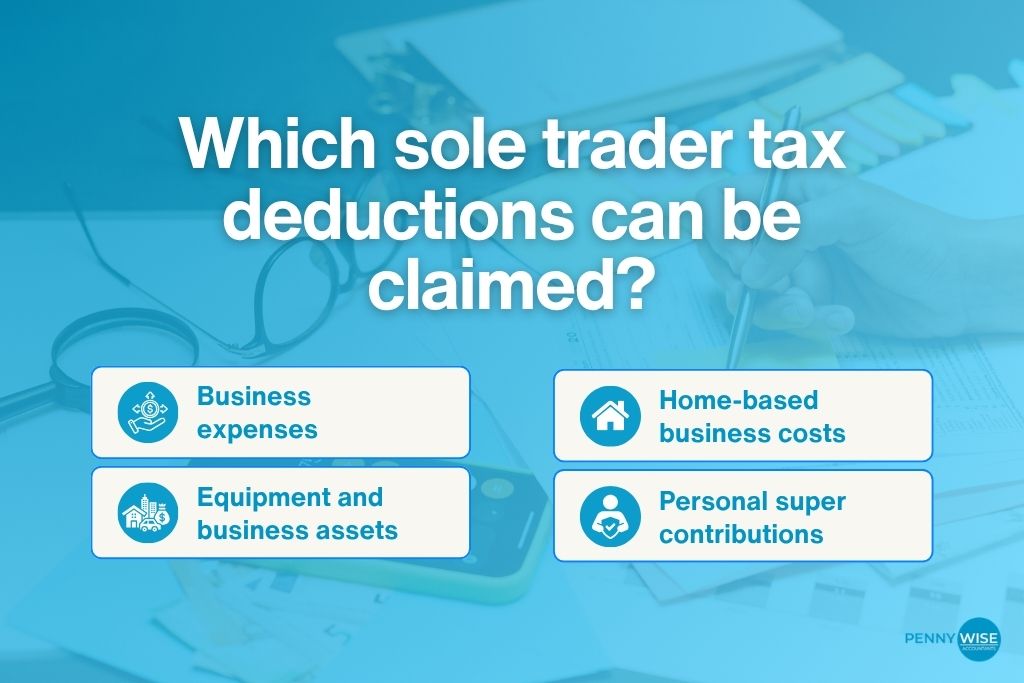
Sole trader tax deductions can reduce taxable income when an expense meets the relevant tax rules.
In general, a business expense needs to be connected to earning assessable business income. Private expenses cannot be claimed, and mixed-use expenses generally need to be divided between business and private use.
Business expenses
Depending on the business and the circumstances, deductions for sole traders can include:
- advertising and marketing costs
- accounting and bookkeeping fees
- insurance connected with earning business income
- business-use phone and internet expenses
- office supplies and software
- eligible motor vehicle costs
- qualifying business travel expenses
- wages and eligible employee costs
- some home-based business expenses
- eligible equipment and business assets
Different rules can apply to each type of expense.
For example, vehicle expenses require an appropriate calculation method and supporting records. Private vehicle use must be excluded.
Business travel can also require careful treatment when a trip includes both business and private purposes.
Phone and internet deductions should be based on a reasonable calculation of business use rather than simply claiming the full bill.
Equipment and business assets
Buying an asset for the business does not always mean the entire cost can be claimed immediately.
Depending on the asset and the tax rules that apply, the cost may qualify for an immediate deduction, may need to be claimed over time through its decline in value, or may be covered by a specific small business concession.
Keeping accurate purchase and use records makes it easier to determine the correct treatment at tax time.
Home-based business costs
Sole traders operating from home may be able to claim some home-based business expenses.
The deductions available depend on the type of expense, how the home is used and the business-use portion of the cost.
Some home-based business claims can also affect capital gains tax when the property is later sold. These deductions therefore need to be considered carefully rather than assuming every household cost can be claimed.
Personal super contributions
Self-employed sole traders do not generally have to pay super guarantee for themselves, but they can make personal super contributions.
An eligible personal contribution may be tax deductible, but the deduction is not automatic. The individual generally needs to give the super fund a valid notice of intent to claim the deduction and receive an acknowledgement from the fund before claiming it.
Contribution caps and other super rules also need to be considered.
A sole trader who employs workers can have separate super obligations. Super guarantee may be required for employees and, in some circumstances, contractors who are treated as employees for super purposes.
How to pay tax as a sole trader in Australia
One important difference between employment and operating a sole trader business is how income tax is paid.
An employer usually withholds tax from an employee’s wages. For a sole trader, tax isn’t automatically withheld from most business income, so money may need to be set aside throughout the year.
What are PAYG instalments?
Pay as you go (PAYG) instalments are payments made during the year towards expected income tax on business and investment income.
The ATO may notify a taxpayer that they have entered the PAYG instalment system based on their tax position and the relevant PAYG rules.
Amounts paid through PAYG instalments are generally credited against the final income tax assessment.
PAYG instalments should not be confused with PAYG withholding. PAYG withholding involves withholding tax from certain payments, such as wages paid to employees.
GST is another separate obligation and may be reported and paid through a business activity statement.
How much money should be set aside for tax?
There is no single percentage that works for every sole trader.
The amount needed will depend on factors such as:
- expected net business income
- other taxable income
- allowable deductions
- tax offsets
- the relevant tax bracket
- Medicare levy
- HELP or other study-loan obligations
Setting aside a fixed percentage of turnover may therefore give an inaccurate estimate.
A better approach is to estimate annual net business income, consider other taxable income and deductions, and then use the relevant individual tax rates to estimate the likely tax bill.
How does a sole trader tax return work?
A sole trader tax return is completed through the individual owner’s personal income tax return.
The sole trader business does not generally lodge a separate company-style income tax return. Instead, the owner reports business income, expenses and the resulting net business income or loss in the relevant sections of the individual return.
When does a sole trader lodge a tax return?
A person carrying on a business as a sole trader generally needs to lodge an income tax return even when income is below the $18,200 tax-free threshold.
For individuals lodging their own return, the usual deadline is 31 October.
Different lodgment dates can apply when a registered tax agent is used. To access the tax agent lodgment program, a person using a tax agent for the first time or changing agents generally needs to contact the agent before 31 October.
What information is generally needed?
A sole trader income tax return usually requires accurate records of business income and deductible expenses.
Depending on the individual’s circumstances, information may also be required for:
- wages and salary
- bank interest
- investment income
- rental income
- capital gains or losses
- personal deductions
- PAYG instalments already paid
- tax offsets
- private health insurance
- Medicare information
Good bookkeeping throughout the year makes this information much easier to prepare at tax time.
What is the small business income tax offset?
Eligible sole traders may qualify for the small business income tax offset.
The offset rate is 16% and can reduce income tax by up to $1,000 per person each year for eligible small business income, subject to the relevant requirements.
It is not simply a flat 16% reduction in business profit. The ATO works out the offset using eligible net small business income and the individual’s basic income tax liability.
The offset is also different from a tax deduction. A deduction reduces taxable income, while an offset reduces tax after the relevant calculation has been made.
What is the difference between sole trader and company tax?
The main difference between sole trader and company tax is the way each business structure is taxed.
A sole trader and the owner are the same taxpayer for income tax purposes. A company is a separate legal and tax entity.
A company is generally taxed as a base rate entity at 25% if its aggregated turnover is under $50 million and no more than 80% of its assessable income is base rate entity passive income, such as interest, dividends and rent. Otherwise, the 30% rate applies.
The company tax rate should not be treated as directly equivalent to a sole trader’s personal tax rate.
Company tax may only be one part of the overall tax outcome. When money is paid from a company to an owner through salary, wages, dividends, loans or other arrangements, additional tax rules can apply.
Dividends can also involve franking credits and may affect the shareholder’s personal tax position.
For this reason, a 25% company tax rate does not automatically mean operating through a company will result in less tax overall.
What are common sole trader tax mistakes?
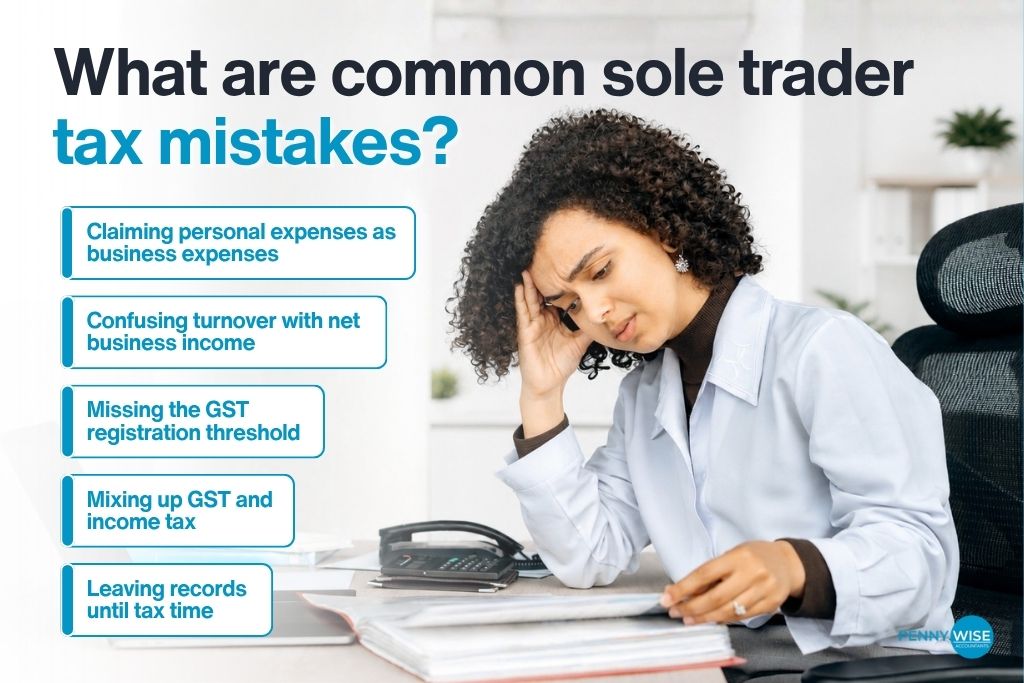
Many common sole trader tax mistakes come from treating tax as something that only needs attention at the end of the financial year.
Regular bookkeeping and a basic understanding of the main tax obligations can prevent many of these issues.
Claiming personal expenses as business expenses
Paying for something from a business bank account does not automatically make it tax-deductible.
If an expense is partly private and partly business-related, only the eligible business portion can generally be claimed.
This commonly applies to:
- mobile phones
- internet
- vehicles
- home expenses
Confusing turnover with net business income
Turnover is not the same as taxable business income.
Turnover generally refers to business sales, while net business income takes allowable expenses and relevant tax adjustments into account.
The amount reported for tax purposes can also differ from ordinary accounting profit because tax rules can affect depreciation, private use, trading stock, capital gains and other items.
Missing the GST registration threshold
GST obligations should be monitored as a business grows.
A sole trader generally needs to consider both current and projected GST turnover when determining whether the $75,000 registration threshold has been reached.
Waiting until the end of the financial year to check turnover can mean the registration requirement has already arisen.
Mixing up GST and income tax
GST and income tax are separate taxes.
For a GST-registered business, GST collected on taxable sales is generally not treated as ordinary business income for income tax purposes, while GST credits can affect how deductible expenses are recorded.
Keeping GST amounts separate helps provide a clearer picture of actual business income and expenses.
Leaving records until tax time
Trying to find a full year of receipts, invoices and transactions at tax time can make preparing a return much harder.
Keeping records up to date throughout the year makes it easier to monitor business income, GST, deductions and the likely tax bill.
It also reduces the risk of missing legitimate deductions or claiming expenses without enough evidence.
Making sole trader tax easier to manage
Sole trader tax becomes easier to manage when tax planning is part of regular business administration rather than something left until the annual return is due.
Accurate bookkeeping can provide a clearer picture of net business income, deductions, GST obligations and the amount that may need to be set aside for tax throughout the year.
At Pennywise Accountants, we help sole traders and small businesses understand their tax and accounting obligations without unnecessary complexity. Our focus is on providing clear information so business owners can understand their numbers and make informed financial decisions.
Every business is different, so tax decisions should be based on the circumstances of the business and its owner.
Frequently asked questions
Continue Reading
Get a personal consultation.
Call us today at 0405 667 350
Fast responses, clear advice, and tailored solutions for Sunbury individuals and small businesses.