
That is where management reporting comes in. It helps business owners understand how their business is performing by turning financial and operational data into practical insights that support better decision-making.
What is management reporting?
Management reporting is the process of collecting, analysing, and presenting business information to help managers and business owners make informed decisions. Unlike financial reporting, which is often prepared for external stakeholders, management reporting is designed for internal use.
A management report combines financial data and operational information to provide a clearer picture of business performance. Rather than simply showing numbers, it helps explain what those numbers mean, what is driving results, and where management attention may be needed.
Why is management reporting important?
Management reporting helps businesses understand what is happening across the organisation and whether performance is tracking in the right direction. It provides visibility over revenue, expenses, profitability, cash flow, and operational performance.
Regular reporting also helps identify issues early. Rather than discovering problems months later, business owners can respond sooner to changing conditions, make informed decisions, and support more effective financial planning for future growth.
How management reporting helps businesses understand performance
Management reporting is not simply about reviewing financial results. Its purpose is to help business owners understand what is driving those results and whether the business is moving in the right direction.
For example, a business may experience growing revenue while profitability remains unchanged. Management reporting helps identify whether rising costs, declining margins, operational inefficiencies, or changes in customer behaviour are affecting overall business performance. This deeper level of insight is what makes reporting such a valuable management tool.
What should a management report include?
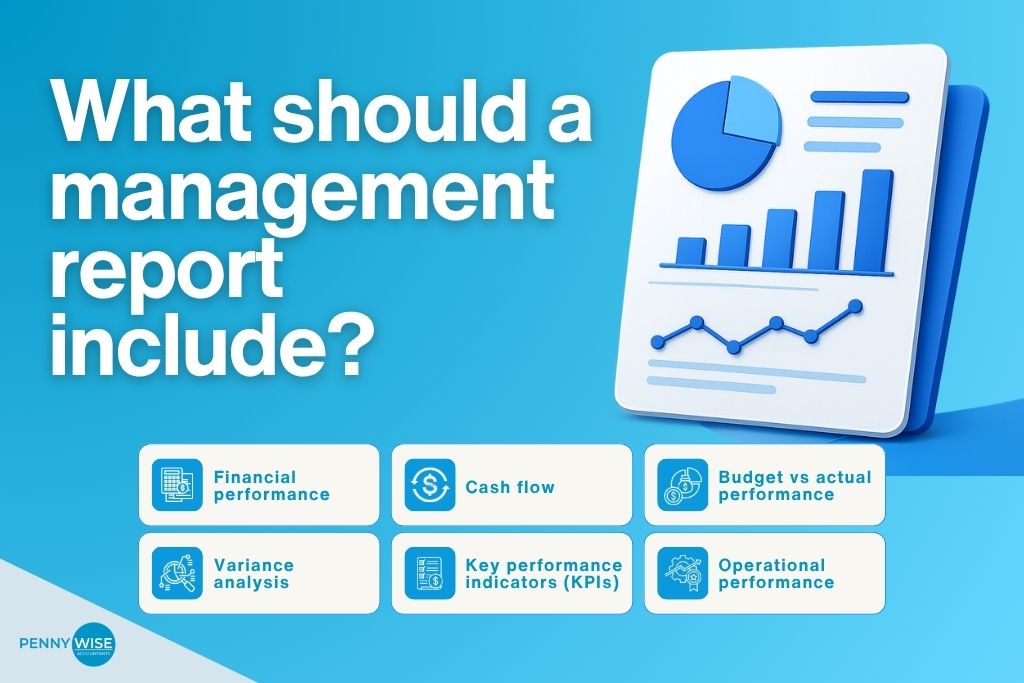
A management report should provide a balanced view of both financial and operational performance. The goal is not to collect as much information as possible, but to present the data that helps management understand business performance and make better decisions.
Most management reports cover four core areas: financial performance, cash flow, key performance indicators (KPIs), and operational performance. Each area answers a different question about the business, and together they give a complete picture of how it is tracking.
Financial performance
Financial performance reporting focuses on revenue, expenses, gross profit, and overall profitability. It helps business owners assess financial health and understand whether the business is achieving its financial objectives.
Management reports often draw information from the balance sheet, profit and loss statement, and cash flow reporting tools to provide a complete picture of financial performance. In many small businesses, cash flow forecasts or cash summaries may also be used to help management monitor short-term financial health and liquidity.
Cash flow
Cash flow reporting shows how money moves through the business and whether sufficient funds are available to meet obligations. This information is essential for planning, forecasting, and maintaining business stability.
Even profitable businesses can experience financial pressure if cash flow is not managed effectively, making this one of the most important sections of any management report.
Many businesses also compare actual cash flow against forecasts to identify unexpected changes. This helps management understand whether the business is performing as expected and whether adjustments may be needed.
Budget vs actual performance
Comparing actual results against budgets is a core part of management reporting. This process helps businesses assess whether revenue, expenses, and profitability are tracking in line with expectations.
Regular budget reviews help identify performance gaps early and provide opportunities to adjust plans before issues have a significant impact on results. When variances appear — whether favourable or unfavourable — the next step is understanding why they occurred. That is where variance analysis adds value.
Variance analysis
Variance analysis builds on budget vs actual comparisons by explaining the reasons behind the differences. Rather than simply showing that costs were higher than expected, it helps management understand what drove that result.
For example, higher-than-expected expenses may be linked to increased supplier costs, while lower sales revenue may reflect changing customer demand. Understanding these drivers helps management respond more effectively and make better-informed decisions going forward. For small businesses, even a simple monthly review of budget versus actual results — with a short note on any significant variances — can make a meaningful difference to financial oversight.
Key performance indicators (KPIs)
KPIs are measurable indicators used to track progress towards business objectives. Common examples include sales growth, profit margins, customer retention, and employee productivity.
Many businesses use a dashboard to present KPI data visually. This makes it easier to monitor trends, compare results over time, and identify areas that require attention.
Operational performance
Operational performance reporting focuses on how effectively the business is running. This may include project performance, customer satisfaction, inventory management, service delivery, or resource utilisation.
These insights help explain why financial results are changing and provide context that financial reporting alone cannot deliver.
What does a management report look like?
Most management reports follow a structured format that allows stakeholders to quickly understand business performance and identify important trends. While reporting formats vary between organisations, the core components are usually similar.
The most effective reports are clear and concise. They focus on the information that matters most and help management move from reviewing data to taking action.
What questions can management reporting answer?
Good management reporting helps business owners answer important questions about how their organisation is performing.
These questions may include:
- Is the business profitable?
- Are profit margins improving or declining?
- Is cash flow strong enough to support growth?
- Which products or services generate the best returns?
- Are operating costs increasing too quickly?
- Are strategic goals being achieved?
- Which areas of the business require immediate attention?
Having answers to these questions helps management focus on the issues that have the greatest impact on business performance.
How management reporting supports better decision-making
The value of management reporting lies in its ability to support informed decision-making. Business owners regularly face decisions about hiring, pricing, marketing investment, equipment purchases, and future growth.
Management reporting reduces uncertainty by providing reliable financial data and operational insights. Instead of relying on assumptions, leaders can evaluate trends, assess risks, and understand the likely impact of future decisions.
For example, reporting may reveal that a particular product generates strong revenue but low profitability. It may also highlight rising customer acquisition costs or declining operational efficiency. These actionable insights help management make decisions based on evidence rather than guesswork.
Types of management reports
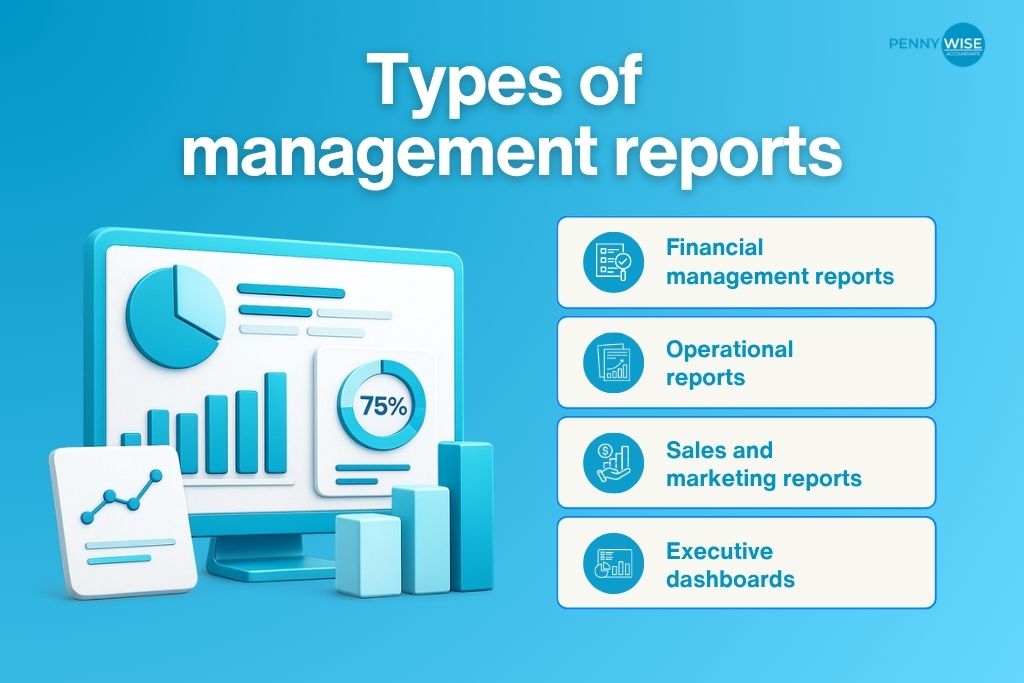
Businesses use different types of management reports depending on their objectives and reporting requirements. Each report focuses on a different aspect of performance and contributes to a broader understanding of business results.
The most common categories include financial management reports, operational reports, sales and marketing reports, and executive dashboards.
Financial management reports
Financial management reports focus on profitability, financial performance, and overall financial health. Common examples include the balance sheet, profit and loss statement, budget reports, and cash flow reports.
For small businesses, these are often the most critical reports to get right. They are typically reviewed monthly or quarterly and form the foundation of sound financial management.
Operational reports
Operational reports measure how efficiently the business is functioning. They often focus on productivity, service delivery, inventory levels, project outcomes, and resource utilisation.
For small businesses, operational reports can highlight where time and resources are being used well — and where improvements could save money or improve customer outcomes.
Sales and marketing reports
Sales and marketing reports provide insights into revenue generation and customer acquisition. They help businesses understand what is driving growth and where marketing efforts are delivering results.
Metrics may include conversion rates, customer acquisition costs, campaign performance, and customer retention trends. For growing businesses, these reports can be particularly useful for assessing the return on marketing investment.
Executive dashboards
Executive dashboards provide a summary view of key business metrics. They allow senior executives and business owners to monitor performance quickly without reviewing detailed internal reports.
Dashboards are especially practical for small business owners who need to stay across multiple areas of the business without spending hours on analysis.
Management reporting vs financial reporting
Management reporting and financial reporting are closely related, but they serve different purposes. Understanding the difference helps businesses use both more effectively.
Management reporting focuses on helping managers run the business, while financial reporting focuses on meeting external reporting obligations.
Building an effective management reporting system
An effective management reporting system starts with identifying the metrics that matter most to the business. Reporting should align with strategic goals and focus on information that supports meaningful decisions.
Reliable reporting also depends on strong data quality. Accurate financial records, consistent reporting processes, and dependable data sources help ensure that management decisions are based on trustworthy information.
The most successful systems provide accurate, timely information that is easy to understand. Overly complex reports often provide less value than reports that clearly communicate the most important insights.
Choosing management reporting software
Management reporting software can help automate data collection, improve reporting accuracy, and provide faster visibility into business performance. For small businesses, the right tool often depends on complexity, budget, and how much reporting is already done through accounting software.
Xero is primarily an accounting platform, and it includes useful reporting features that suit many small businesses. Tools such as Fathom are designed specifically for management reporting and KPI analysis, and integrate well with Xero. For businesses that need more advanced dashboards or handle larger data sets, Microsoft Power BI and Tableau are worth considering, though they typically suit larger organisations or those with dedicated reporting resources.
Common management reporting mistakes
One of the most common mistakes is focusing on too many metrics at once. Effective management reporting focuses on the information that has the greatest impact on business performance rather than tracking every available number.
Another common issue is failing to act on reporting insights. Reports should support decisions and improvements, not simply document performance. The most effective reporting processes convert information into action.
How often should management reports be reviewed?
For many small businesses, monthly management reporting provides the best balance between visibility and practicality. Monthly reviews help identify trends early and provide enough time to respond to emerging issues.
Quarterly reporting can also be useful for reviewing strategic goals, evaluating longer-term performance trends, and supporting business planning.
The future of management reporting
Management reporting continues to evolve as technology improves. Automation, business intelligence platforms, and real-time dashboards are making it easier for businesses to access accurate information and generate insights quickly.
Artificial intelligence tools are increasingly being applied to forecasting, trend analysis, and reporting automation. For some businesses, these tools can help identify patterns faster and handle larger volumes of data more efficiently — though the level of adoption and practical benefit varies considerably depending on the business and the tools in use.
Using management reporting to drive business growth
Management reporting is more than a collection of reports. It is a practical framework for understanding business performance, evaluating financial health, and making better decisions.
At Pennywise Accountants, we often find that business owners already have access to valuable financial data but are not always using it effectively. Management reporting helps turn that information into practical insights that support stronger decision-making, better financial management, and sustainable business growth.
Good reporting does more than explain what has happened. It helps business leaders understand what is driving results and what actions should come next.
Frequently asked questions
How can small businesses use management reporting to improve cash flow?
Management reporting helps small businesses monitor cash inflows, outflows, and upcoming financial obligations. By reviewing cash flow trends each month, businesses can identify potential shortfalls before they become serious and make better decisions about spending, timing, and investment.
What are the signs that a business needs better management reporting?
Common signs include reacting to financial problems rather than anticipating them, having limited visibility over cash flow or profitability, or not knowing which areas of the business are performing well and which are not. If reporting feels more like a compliance exercise than a useful tool, it’s worth reviewing the process.
Who should review management reports within a business?
Management reports are typically reviewed by business owners, department managers, and senior executives. Each person may focus on different metrics depending on their responsibilities. Regular reviews help ensure decisions remain aligned with overall business goals.
Can management reporting help identify unprofitable products or services?
Yes, management reporting can highlight which products, services, or business areas contribute most to profitability. By comparing revenue, costs, and margins, businesses can identify offerings that are underperforming. This information can support pricing adjustments, cost reductions, or strategic changes to improve overall financial performance.
How long does it take to implement a management reporting system?
The time required depends on the size and complexity of the business. Smaller businesses with organised financial data can often implement a reporting system within a few weeks. Larger organisations may require additional time to integrate systems, define KPIs, and establish reporting processes.
What makes a management report useful for decision-making?
Useful reports are focused, timely, and easy to act on. They cover the metrics that matter most to the business, present data in a format that makes trends visible, and include enough context for management to understand what the numbers mean — not just what they are.
Do small businesses need management reporting software?
Not necessarily. Many small businesses start with a combination of accounting software and spreadsheets, which can be sufficient in the early stages. Dedicated reporting software tends to become more valuable as the business grows, reporting becomes more complex, or the time spent on manual reporting outweighs the cost of a tool.
How does management reporting support business growth?
By providing consistent visibility into profitability, cash flow, and operational efficiency, management reporting helps business owners identify growth opportunities, allocate resources effectively, and assess whether strategic initiatives are delivering expected results.
Continue Reading

Get a personal consultation.
Call us today at 0405 667 350
Fast responses, clear advice, and tailored solutions for Sunbury individuals and small businesses.