
GST Inclusive vs Exclusive: What It Means on Quotes and Invoices
A small difference in how GST is displayed can change the final amount a customer pays.
Read article →
Businesses registered for GST generally collect the tax from customers, claim eligible credits on business purchases and pay the difference to the Australian Taxation Office (ATO).
Understanding how GST works is essential for managing business finances and meeting Australian tax obligations. This guide explains the GST rate, registration thresholds, calculations, tax invoices and reporting requirements for 2026.
GST is a consumption tax included in the price of most taxable goods and services. Introduced on 1 July 2000, it forms part of the Australian tax system and is administered by the ATO.
Businesses registered for GST charge the tax on eligible sales and collect GST from customers. Rather than keeping the full amount received, they account for GST separately and report their obligations through a Business Activity Statement (BAS).
Registered businesses can also claim credits for the GST paid on eligible business purchases, called input tax credits. The difference between GST collected on sales and allowable credits determines the net amount payable or refundable.
Consumers generally bear the final cost of GST because the tax is included in the purchase price. Businesses operating in Australia collect the tax and transfer the relevant amount to the ATO.
For example, a business selling a taxable product for $100 excluding GST adds $10 in tax, bringing the customer’s total to $110. The business then accounts for the $10 when preparing its GST reporting.
The GST rate Australia applies in 2026 is 10% for taxable goods and services. This standard rate has remained unchanged since the tax was introduced in July 2000.
GST is charged on most goods and services sold or consumed in Australia, provided the supplier is registered or required to be registered, and the sale is taxable.
Common examples include:
Businesses should identify whether each sale is taxable before deciding to include GST in the price.
Some goods and services are GST-free, meaning GST is not charged even when the supplier is registered. Common examples include most basic groceries, eligible medical services, certain education courses and qualifying exports.
GST-free sales differ from input-taxed sales. Both generally have no GST charged to the customer, but eligible purchases relating to GST-free sales can attract GST credits, while purchases relating to input-taxed sales generally cannot.
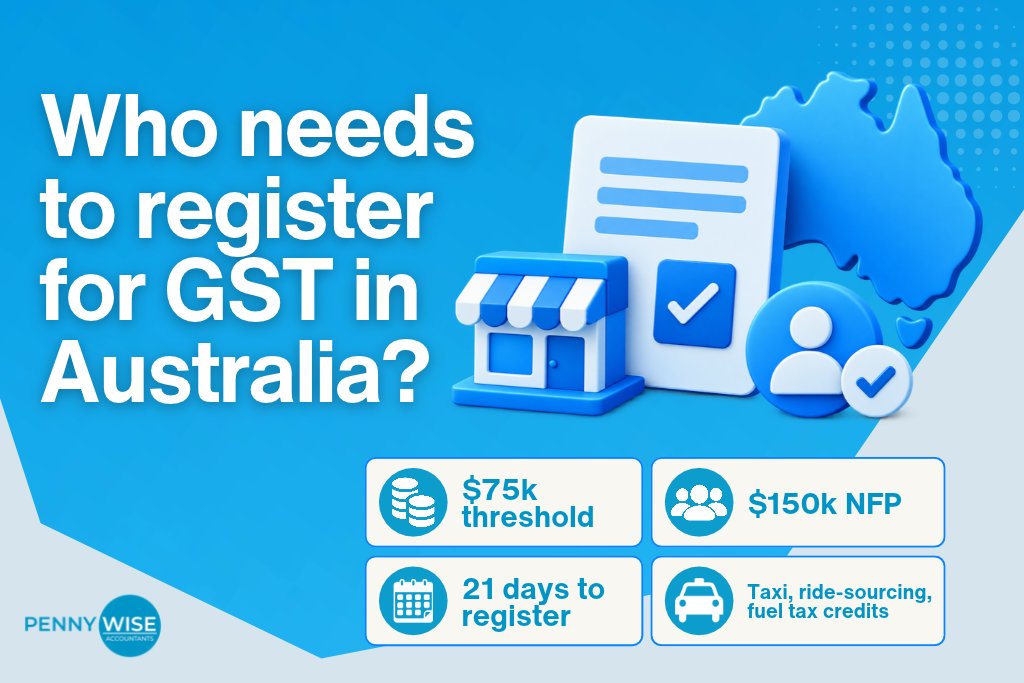
Australian businesses must register for GST when their GST turnover reaches or is expected to reach $75,000. Different rules apply to certain organisations and activities, regardless of their annual sales.
The standard GST registration threshold is $75,000 in annual GST turnover, while the threshold for not-for-profit organisations is $150,000.
GST turnover generally includes taxable and GST-free sales but excludes GST itself, input-taxed sales and certain other transactions. Both current and projected turnover are relevant when assessing registration requirements.
A business approaching the threshold should regularly review its sales and forecasts. Once registration becomes compulsory, the business generally has 21 days to register.
Small business operators with turnover below $75,000 can voluntarily register for GST. This may be useful when significant eligible business purchases generate credits that can be claimed.
However, voluntary registration also creates ongoing obligations to charge GST on taxable sales, maintain records and lodge activity statements. The additional administration should be considered before registration.
Businesses providing taxi travel or ride-sourcing services must register for GST even when their turnover is below $75,000. This requirement includes relevant transport services arranged through digital platforms.
Businesses intending to claim fuel tax credits must also register for GST. These circumstances require separate consideration rather than relying solely on the usual turnover threshold.
A business can register for GST through the ATO’s online services, by telephone or through a registered tax or BAS agent. An Australian Business Number (ABN) is generally required before GST registration can be completed.
The ATO GST registration process generally involves:
Businesses must register for GST when registration becomes compulsory and should avoid charging GST before the registration takes effect.
To calculate GST on a fully taxable sale, multiply the GST-exclusive price by 10%. When the total already includes GST, divide that amount by 11 to identify the GST component.
A business charging $500 excluding GST would calculate the tax as follows:
The business can calculate GST-inclusive prices directly by multiplying the original price by 1.1.
When a tax invoice shows $330 including GST, the calculation is different:
Dividing a GST-inclusive price by 10 instead of 11 is a common calculation mistake. The division-by-11 method applies where the entire amount is subject to the standard GST rate.
GST-registered businesses can generally claim GST credits on eligible purchases used in their business activities. These credits reduce the tax payable on taxable sales and may result in a refund when allowable credits exceed the GST collected.
Eligible expenses can include equipment, office supplies, professional services and other purchases used to operate the business.
To claim GST credits, the business generally needs to:
For purchases exceeding $82.50 including GST, a valid tax invoice is generally required before claiming GST credits.
The amount of GST a business owes depends on the GST collected from customers minus the GST credits claimed on eligible business purchases.
For example, consider a small business with $22,000 in fully taxable sales and $5,500 in eligible business purchases, both including GST.
| GST Calculation | Amount |
|---|---|
| GST collected on sales ($22,000 ÷ 11) | $2,000 |
| GST credits on purchases ($5,500 ÷ 11) | $500 |
| Net GST payable to the ATO | $1,500 |
In this example, the business would pay $1,500 in GST to the ATO after deducting $500 in eligible credits from the $2,000 collected on sales.
Keeping accurate records of sales and business expenses helps businesses calculate their GST liability correctly and avoid errors when preparing their BAS.
GST-registered businesses report and pay GST through a BAS, which records relevant sales, GST liabilities and credits. The reporting frequency depends on annual GST turnover and the business’s circumstances.
Businesses with GST turnover below $20 million can generally report GST quarterly, while those with turnover of $20 million or more must generally report monthly.
Eligible voluntarily registered businesses below the registration threshold may be able to report annually. BAS lodgement periods and deadlines should be confirmed for the applicable reporting cycle.
GST accounting can follow either the cash or non-cash (accruals) method, depending on eligibility and the chosen accounting approach. Under cash accounting, GST is generally reported when payments are received or made. Under accrual accounting, GST may become reportable when an invoice is issued or received, even if payment has not occurred.
Cash accounting is available to eligible businesses with aggregated turnover below $10 million. The selected method affects cash flow and the timing of GST reporting.
Businesses can manage BAS obligations through different methods depending on transaction volume, available systems and support requirements.
| Reporting Option | Best Suited To | Main Benefit | Key Consideration | Where to Access |
|---|---|---|---|---|
| ATO online services | Simple business records | Direct lodgement | Manual preparation | ATO |
| Xero | Businesses needing cloud bookkeeping | Automated GST tracking | Subscription and setup | Xero |
| MYOB | Businesses managing invoicing and payroll | Integrated records | Plan suitability | MYOB |
| QuickBooks | Smaller businesses seeking online accounting | Sales and expense tracking | Accurate configuration | QuickBooks |
| Registered tax or BAS agent | Complex GST obligations | Professional review and lodgement | Service fees | Registered practitioner |
Accounting software can simplify GST reporting, but the quality of the resulting BAS depends on accurate transaction coding and complete financial records.
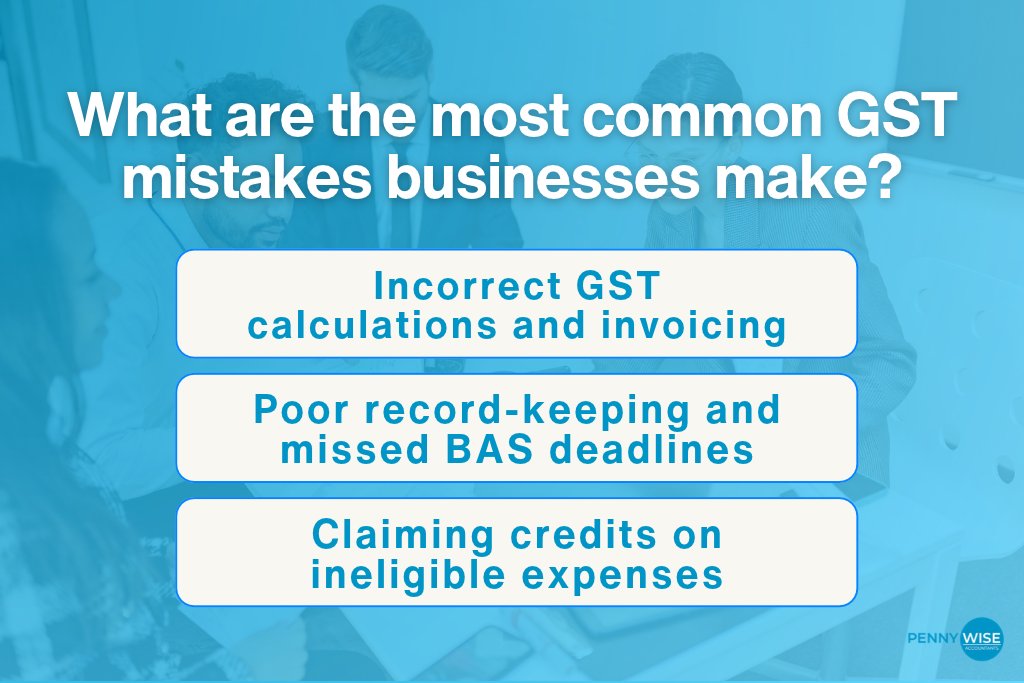
Common GST mistakes include incorrect calculations, missed registration deadlines, incomplete tax invoices and claiming credits on ineligible purchases. These errors can affect GST compliance and create additional reporting work.
Businesses sometimes calculate GST incorrectly by dividing a GST-inclusive invoice by 10 rather than 11. Other errors occur when transactions are classified as taxable despite being GST-free or input-taxed.
Australian Consumer Law generally requires advertised consumer prices to clearly display the total payable amount, including applicable taxes. Businesses should ensure customer pricing and tax invoices reflect the correct GST treatment.
Missing receipts, incorrectly coded transactions and inconsistent bookkeeping can make it difficult to report the GST collected and verify credits on business purchases. Australian businesses generally need to retain GST records for five years. Maintaining complete records and reviewing reports before lodgement can reduce avoidable errors.
Claiming GST on personal expenses, GST-free purchases or expenses relating to input-taxed activities can lead to incorrect credits. Businesses should also account for GST only on the eligible business-use portion of mixed-use purchases. Accurate classifications help maintain compliance and reduce the risk of adjustments.
Understanding GST starts with knowing which sales are taxable, when registration is required and how to calculate the amount payable. Accurate invoicing, record-keeping and regular BAS reporting help businesses manage their responsibilities under the Australian tax system.
At Pennywise Accountants, we assist businesses with GST registration, bookkeeping, BAS preparation and tax compliance. Our approach focuses on maintaining accurate financial records and helping businesses meet their reporting obligations with greater confidence.
GST stands for Goods and Services Tax, a broad-based consumption tax applied to most taxable goods and services in Australia. The standard rate is 10%, and the system has operated since 1 July 2000. Registered businesses collect GST on eligible sales and may claim credits on qualifying expenses, subject to the applicable tax rules.
GST and income tax are different types of taxation in Australia. GST generally applies to taxable goods and services, while income tax applies to assessable income after relevant deductions and adjustments. Businesses may have obligations for both taxes, but they are calculated and reported differently, with GST commonly included in BAS reporting.
A fully taxable $1,100 invoice that already includes GST contains $100 in GST and $1,000 before tax. The GST component is calculated by dividing the inclusive amount by 11. If $1,100 is instead the price excluding GST, an additional $110 would be charged, bringing the total to $1,210.
A sole trader generally cannot claim GST credits without being registered for GST. Registration is compulsory when the relevant turnover threshold is reached or another registration requirement applies. Sole traders below the threshold may register voluntarily, allowing them to claim eligible credits while also accepting the associated tax collection and reporting obligations.
GST registration may be processed immediately when completed online, although some applications require additional checks. Processing times depend on the business’s details, ABN status and the verification required by the ATO. The important compliance deadline is that businesses generally have 21 days to register after becoming required to do so.
A GST-registered business that fails to charge GST on a taxable sale may still be liable for the tax. The business may need to correct its records, review the original invoice and determine whether a BAS adjustment is necessary. Outstanding liabilities, interest or penalties may arise depending on the circumstances.
Voluntary GST registration may benefit a small business with substantial eligible expenses because it can allow GST credits to be claimed. However, registration also creates obligations to charge tax on taxable sales and lodge the required statements. The decision depends on the business’s customer base, expenses, pricing arrangements and administrative capacity.
Overseas businesses may need to register for Australian GST when making certain taxable supplies connected with Australia and meeting the applicable registration requirements. Sales of imported services, digital products or low-value goods to Australian consumers may be covered by special rules. Registration depends on the type of supply, customer and turnover involved.
This article is general information only and does not constitute personalised tax or financial advice. Speak to a registered tax agent about your circumstances.
Book an initial call and we’ll talk through what it means for your numbers.
A small difference in how GST is displayed can change the final amount a customer pays.
Read article →
For growing Victorian businesses, payroll tax can become relevant sooner than expected.
Read article →
Understanding sole trader tax in Australia can feel complicated at first, but the basic idea is fairly simple.
Read article →Trusted & Certified


 Pennywise Accountants is a CPA practice.