
What Is GST in Australia? A Complete Guide
GST in Australia is a 10% goods and services tax applied to most products and services sold or consumed in the country.
Read article →
GST inclusive vs exclusive refers to whether the 10% Goods and Services Tax (GST) is already included in a price or needs to be added. A GST-inclusive price is the final amount payable, while a GST-exclusive price requires an additional 10% for taxable sales in Australia.
Understanding the difference helps Australian businesses prepare accurate quotes, issue invoices and manage their tax obligations. This guide explains both pricing methods, how to calculate GST and what businesses should check before charging customers.
The main difference is whether GST has already been included in the advertised price. Both methods account for the same 10% tax on taxable sales, but they present the amount differently.
GST inclusive means the price already contains the 10% tax. When an item costs $110 including GST, the customer pays $110 in total, with $10 representing the tax component.
Terms such as incl GST, inc GST and tax inclusive all indicate that the applicable tax is already part of the displayed amount. No additional GST needs to be added at payment.
GST exclusive means the price is shown before tax is added. If a service costs $100 excluding GST, another $10 is added on top, bringing the total to $110.
Businesses may use ex GST, ex-GST, excl GST or plus GST to indicate exclusive pricing. These terms commonly appear on business quotes, wholesale price lists and invoices.
The table below shows how GST-inclusive, GST-exclusive and GST-free pricing affect the final amount payable.
| Pricing method | Base price | GST component | Total payable |
|---|---|---|---|
| GST inclusive | $100 | $10 included | $110 |
| GST exclusive | $100 | $10 added | $110 |
| GST-free sale | $100 | $0 | $100 |
The first two examples produce the same total price when the underlying pre-tax amount is $100. The GST-free example differs because no GST applies to that sale.
GST calculations use Australia’s standard 10% rate for taxable goods and services. The correct calculation depends on whether the starting price already includes GST.
To add GST, multiply the GST-exclusive amount by 1.10. The result includes both the original amount and the additional 10% tax.
For example, a business charging $250 before GST would calculate:
Formula: GST-inclusive price = GST-exclusive price × 1.10
This calculation is useful when preparing a quote or setting prices for taxable services. The resulting $275 is the full amount the customer must pay.
To remove GST from a price that already includes tax, divide the amount by 1.10. This reveals the original price before GST was applied.
For example, an item costing $330 including GST would have the following breakdown:
Formula: GST-exclusive price = GST-inclusive price ÷ 1.10
A common mistake is subtracting 10% from the inclusive total. The correct GST amount is one-eleventh of the GST-inclusive price, rather than 10% of that final amount.
The GST component of a fully taxable, GST-inclusive amount can be calculated by dividing the total by 11. For a $220 purchase, the GST amount is $20, leaving a $200 pre-tax price.
A GST calculator can help businesses perform these calculations quickly. However, the correct GST treatment still needs to be checked, particularly when an invoice includes taxable and non-taxable items.
Quotes and invoices should clearly distinguish the amount before GST, the applicable tax and the final amount payable. Consistent formatting reduces pricing confusion and supports accurate financial records.
A quote should state whether the listed amount includes GST and identify any additional charges. Clear wording helps customers understand the amount they are agreeing to pay.
For example, a tradie providing renovation services might prepare the following estimate:
| Description | Amount |
|---|---|
| Labour and materials (excl GST) | $1,500 |
| GST (10%) | $150 |
| Total including GST | $1,650 |
This format makes the pricing calculation transparent. For consumer-facing quotes, the full payable amount must also be displayed prominently, consistent with Australian Consumer Law.
An invoice for a taxable sale should identify the GST treatment and provide the required transaction details. A compliant tax invoice generally includes a clear "tax invoice" label, the supplier’s identity, ABN, issue date, description of the supply and relevant tax information.
According to the Australian Taxation Office (ATO), additional recipient details are generally required for tax invoices totalling $1,000 or more. The GST amount must also be identifiable, whether shown separately or through an appropriate statement that the total includes GST.
A simple invoice might show:
For a fully taxable invoice, the GST line can make the breakdown particularly easy to understand. Where different tax treatments apply, the invoice must contain enough information to identify the taxable supplies.
The appropriate pricing format depends on whether a business sells to consumers or other businesses. Australian Consumer Law places particular emphasis on clearly displaying the total amount payable to consumers.
Consumer-facing businesses generally need to display prices that include GST and other unavoidable charges. This applies to retail stores, online shops and many businesses offering services to the general public.
For example, retailers such as supermarkets and hardware stores commonly display final retail prices rather than adding GST separately at checkout.
The Australian Competition and Consumer Commission (ACCC) states that businesses must display the minimum total price as a single figure, including applicable taxes and unavoidable fees. Where a partial price is also shown, the total price must be at least as prominent.
GST-exclusive pricing is commonly used for business-to-business (B2B) quotes, wholesale arrangements and supplier agreements. It allows businesses to identify the underlying cost before tax.
The ACCC explains that prices displayed only to other businesses do not need to include GST in the total price. It is still good practice to make the amount payable and the GST clear before the transaction proceeds.
For Australian businesses comparing supplier costs, distinguishing the pre-tax price can also support budgeting and expense tracking.
Worked examples show how the same 10% rate applies across different pricing situations. The calculation depends on the tax status of the sale and the amount initially displayed.
An Australian consulting business charges $800 plus GST for a taxable service. The GST is added at 10%, resulting in an $880 invoice total.
If the agreed fee were instead $800 including GST, the customer would pay $800 in total and the GST component would be approximately $72.73. The distinction matters when estimating revenue before tax.
A customer purchases a taxable household item priced at $110 including GST. The price already contains the $10 tax component, so there is no additional amount to calculate at checkout.
For the retailer, the amount before GST is $100. The retailer records the relevant tax component according to its GST accounting method.
A business sells $200 worth of taxable products and $50 worth of GST-free products. The taxable items attract $20 GST, while the GST-free items attract none.
The resulting invoice totals $270. Applying 10% to the entire $250 subtotal would incorrectly charge GST on the GST-free portion.
GST calculations can be managed using accounting software, spreadsheet templates or basic calculators. The most suitable option depends on transaction volume, reporting requirements and the complexity of the business.
| Tool or method | GST handling | Best suited for | Main consideration | Where to access |
|---|---|---|---|---|
| QuickBooks | Tax-inclusive and tax-exclusive transactions | Small businesses issuing regular invoices | Check tax codes and invoice settings | QuickBooks |
| Xero | GST tracking and invoicing | Businesses managing regular sales and expenses | Confirm tax rates for each transaction | Xero |
| Excel invoice template | Manual formulas and calculations | Businesses with simple invoicing needs | Requires manual checking | Microsoft |
| GST calculator | Adds or removes GST | Quick, individual calculations | Does not replace tax records | Online GST calculator providers |
QuickBooks and Xero provide broader accounting functionality than a standalone calculator. However, software does not automatically determine whether every transaction is taxable, GST-free or input-taxed.
Businesses should confirm the correct tax treatment before relying on automatically generated totals.
GST-inclusive and exclusive amounts affect how businesses record sales, expenses and tax obligations. For GST-registered businesses, the tax collected on sales and eligible credits on purchases contribute to their Business Activity Statement (BAS).
A GST-registered business may be eligible to claim a GST credit, also called an input tax credit, for GST paid on qualifying business purchases. Eligibility depends on the purchase, its business use and the supporting records.
For example, a $1,100 taxable purchase includes $100 GST. If the business qualifies for the full credit, that $100 may be claimed through its GST reporting.
The ATO generally requires a valid tax invoice to support GST credit claims for purchases above $82.50 including GST, subject to applicable exceptions.
Not every sale attracts the standard 10% rate. GST-free sales can include certain basic foods, healthcare services, education services and eligible overseas exports.
Input-taxed sales, including residential rent and certain financial services, also generally have no GST charged. However, the rules for claiming related GST credits differ between GST-free and input-taxed activities.
Correct classification is essential because applying the standard rate to every transaction can produce inaccurate tax records.
According to Business.gov.au, businesses generally must register for GST when their GST turnover reaches $75,000, with different thresholds or rules for certain organisations and activities.
Businesses below the threshold may choose voluntary registration. An unregistered business generally cannot charge GST or claim GST credits, so its invoices should not show GST as though it were collected.
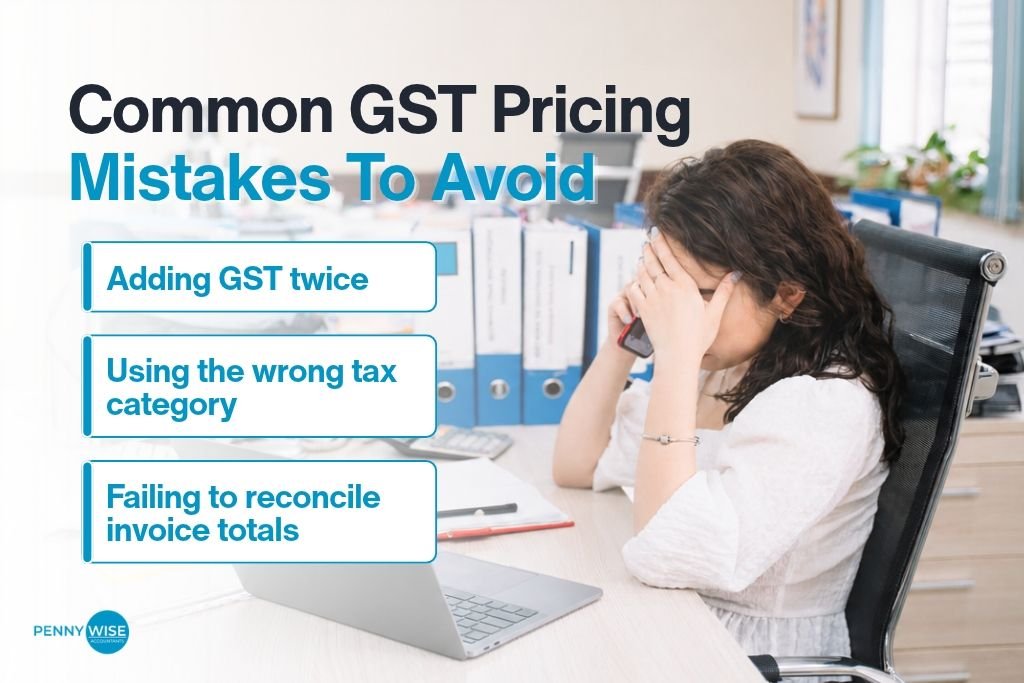
GST mistakes often arise from unclear pricing labels, incorrect calculations or inconsistent invoice settings. Regular checks can help businesses identify problems before they affect customer payments or tax reporting.
Double charging can occur when GST is added to an amount that already contains the tax. For example, adding another 10% to a $110 inclusive price incorrectly increases the total to $121.
The original $110 already includes the $10 tax component. Accounting software should therefore be configured to recognise whether entered prices are inclusive or exclusive.
Some businesses apply the standard GST rate to every sale without checking whether an exemption or different treatment applies. GST-free food and eligible services may require a different tax category.
The relevant classification should be checked before issuing an invoice. This is particularly important for businesses selling a combination of taxable and GST-free products.
Incorrect settings can cause differences between quoted prices, customer payments and accounting records. A bookkeeper may identify these discrepancies while preparing monthly reconciliations or BAS reports.
A practical review should confirm the original price, GST treatment, tax component and final amount. Consistent invoice templates can also make discrepancies easier to identify.
GST-inclusive pricing already contains the applicable tax, while GST-exclusive pricing requires GST to be added before determining the final amount payable. Understanding the difference supports accurate pricing, clearer invoices and better financial reporting.
At Pennywise Accountants, we help Australian businesses manage bookkeeping, taxation and financial records with accuracy and clarity. Our approach focuses on keeping GST calculations and reporting consistent with each business’s obligations.
Need help managing GST for a business? Contact us today to see how we can help.
Inc GST means the amount shown already includes any applicable Goods and Services Tax. For a fully taxable purchase of $55, the GST component is $5, and the original price before tax is $50. Customers do not need to pay an additional 10% when the receipt displays a GST-inclusive total.
A $1,000 price that includes Australia’s standard 10% GST contains approximately $90.91 in tax. The amount before GST is approximately $909.09, calculated by dividing $1,000 by 1.10. This calculation applies when the entire purchase is taxable, and the $1,000 figure already includes GST.
GST-inclusive pricing is generally more suitable for businesses selling directly to consumers, while exclusive pricing can be useful for business-to-business transactions. The better option depends on the customer and applicable pricing requirements. Regardless of presentation, GST-registered businesses must calculate the correct tax and communicate the total payable clearly.
GST is calculated by applying the correct tax treatment to each invoice item and combining the resulting amounts. For example, $100 of taxable goods attracts $10 GST, while $40 of GST-free goods attracts none. The invoice total would therefore be $150, assuming no other charges or adjustments apply.
A business cannot automatically add GST to an agreed price simply because the original quote did not mention it. Whether an additional charge is permitted depends on the agreement, applicable contract terms and consumer law. Clear pricing terms should establish the GST treatment before acceptance to reduce the risk of disputes.
A business generally must be registered for GST, or required to be registered, to charge GST on taxable sales. The usual registration threshold is $75,000 in GST turnover, although certain activities have different rules. Businesses that are not registered and are not required to register should not add GST to their invoices.
GST credits may be claimed on eligible business purchases containing GST when the purchaser is registered for GST and meets the relevant requirements. A valid tax invoice is generally needed for purchases above $82.50 including GST, subject to exceptions. GST-free purchases contain no GST to claim, while input-taxed activities can restrict credit eligibility.
An invoice with an incorrect GST amount may require correction to ensure the customer and business records reflect the proper tax treatment. The supplier may need to issue a corrected tax invoice or adjustment document, depending on the circumstances. Businesses should also check whether the error affects previously submitted BAS information.
This article is general information only and does not constitute personalised tax or financial advice. Speak to a registered tax agent about your circumstances.
Book an initial call and we’ll talk through what it means for your numbers.
GST in Australia is a 10% goods and services tax applied to most products and services sold or consumed in the country.
Read article →
For growing Victorian businesses, payroll tax can become relevant sooner than expected.
Read article →
Understanding sole trader tax in Australia can feel complicated at first, but the basic idea is fairly simple.
Read article →Trusted & Certified


 Pennywise Accountants is a CPA practice.